German CV Format: How to Write a Lebenslauf That Fits Germany in 2026
The German CV format explained for international applicants: length, order, dates, photo, personal details and signature, with a before and after example and official sources.

DeutschCV Team
The team behind DeutschCV

On this page
Turn your CV into a Lebenslauf
- Free Germany check
- Lebenslauf and Anschreiben
- One-PDF Bewerbungsmappe
No account needed
You have a strong CV. It got you interviews at home. Then you apply in Germany, and the answer is silence, or a polite "we chose other candidates." Nothing in your experience changed. What changed is the format, and in Germany the format is read as a signal of whether you understand how things are done.
This guide is the hub for everything we publish about the German CV. It shows what a Lebenslauf looks like, how it differs from a US or UK resume, and which parts are required, optional or best left out. Where a claim comes from an official page, we link it. Where something is custom rather than rule, we say so.
TL;DR: A German CV (Lebenslauf) is a tabular, reverse-chronological document of one to two A4 pages, with month and year for every station, your personal details at the top, and a place, date and signature line at the end. A photo is no longer a must. Everything else is detail, and the detail is below.
What is a Lebenslauf?
A Lebenslauf is the German word for a CV: a structured summary of your career history and qualifications. The Federal Employment Agency (Bundesagentur für Arbeit) describes it as the part of an application that summarises your career in a structured way, and tells applicants to write it in tabular form on one to two A4 pages (arbeitsagentur.de, Lebenslauf).
It is not a marketing brochure. German recruiters expect to find facts in predictable places. A US resume opens with a punchy summary and bullet points full of results. A Lebenslauf opens with who you are and then lets the table do the work.
German CV vs US resume: the differences that matter
The two documents answer different questions. The US resume asks "why should we be excited?" The Lebenslauf asks "does this person's path add up, and is it documented?"
| Element | US resume | German Lebenslauf |
|---|---|---|
| Length | One page is the norm | One to two A4 pages |
| Page size | Letter | A4 |
| Top of page | Name and a summary | Name, contact data and personal details |
| Photo | Rare, often discouraged | Optional, still common in many industries |
| Dates | Often years only, or Month YYYY | Month and year per station, usually MM/YYYY |
| Layout | Bullet points under each job | Table: dates on the left, details on the right |
| Order | Reverse chronological | Reverse chronological |
| Language skills | A line in Skills | Own section, with levels |
| Ending | Nothing | Place, date, optionally a signature |
| Cover document | Cover letter | Anschreiben, plus often a full Bewerbungsmappe |
If you want the cover letter side of this, read how to write an Anschreiben. If you want the full package, see the Bewerbungsmappe checklist.
The seven parts of a German CV, in order
There is no law that prescribes a Lebenslauf layout, so what follows is the common convention, anchored on what the Bundesagentur für Arbeit tells applicants.
- Header with personal details. Full name, address, phone, email. The Bundesagentur lists name, address, phone, email, date of birth and place of birth as the personal details of a CV, and says details about your parents' occupations are not required. It also says details about family and nationality are voluntary.
- Photo (optional). Covered in its own section below.
- Work experience (Berufserfahrung). Newest first.
- Education (Ausbildung, Studium). Newest first.
- Special knowledge (Besondere Kenntnisse). The Bundesagentur names foreign languages, computer skills and a driving licence here, when they matter for the job.
- Interests (optional). Hobbies or volunteering can be mentioned briefly.
- Place, date and signature. A signature is not strictly necessary, according to the Bundesagentur, but it can show the document is current.
Order: newest first, one table
"Beginne mit dem Abschnitt, der am kürzesten zurückliegt," is the Bundesagentur's instruction: start with the section that is closest to today. That is reverse chronological order, and it applies inside each section too.
The table layout is the visible trademark of the German CV. The left column carries the period (for example 03/2021 – 08/2024). The right column carries the employer, your job title and two to four lines of what you did. This is why a two-column layout built in a design tool can feel off to a German reader: it breaks the left-to-right pattern the eye expects. That is our reading of the convention, not an official rule.
Dates: month and year, every time
The Bundesagentur's rule is short: for each station you give a start and end date, and "Monat und Jahr sind dabei ausreichend", month and year are enough. You do not need days.
Two things trip up international applicants:
- Writing only years. "2021 – 2024" leaves gaps a German reader will notice. "03/2021 – 08/2024" does not.
- US date order. In Germany the day comes first and the month second.
04/05/2024is 4 May, not April 5. In a CV you avoid the problem by usingMM/YYYY, which cannot be misread.
If you were employed until today, write "seit 03/2021" or "03/2021 – heute". If you want to explain a gap (parental leave, relocation, a language course), put it in the table as its own row. A labelled gap reads better than an unexplained one.
Photo and date of birth
Both are the questions we hear most, so they have their own post. The short version:
- On the photo the Bundesagentur is explicit: it writes that a photo is "kein Muss mehr" (no longer a must), and that it is still customary in many industries. If you apply through a portal, it may ask you to upload one separately.
- On the date of birth the Bundesagentur lists it, with place of birth, among the standard personal details. We found no official page that makes it mandatory, but we also found none that tells you to leave it out. The decision is yours.
Language skills and CEFR levels
Germans expect language skills in a dedicated block with a level next to each language. The standard scale is the Common European Framework of Reference (CEFR): A1 and A2 for basic users, B1 and B2 for independent users, C1 and C2 for proficient users. Our CEFR guide shows how to print them and what to do if you have no certificate.
A practical rule: name the level, then the proof. "German: B1 (Goethe-Zertifikat B1, 06/2025)" is stronger than "German: intermediate." "English: native" or "English: C2" is fine without a certificate.
Education: what to list and how
List degrees newest first. Give the period, the degree, the institution and the city and country. For a foreign degree, keep the original name in the table and add the closest German equivalent only when you are sure. If you are unsure whether your qualification is recognised, the federal portal Anerkennung in Deutschland is the official place to find out how recognition works and where to get advice.
Do not list your school grades from 15 years ago. If a degree is the highest qualification you have, one row for it is enough.
Work experience: tell it as a table, not a story
Each row has the same pattern:
03/2021 – 08/2024   Product Analyst, Northwind Logistics, Lisbon
                    - Built the weekly demand forecast used by five regional teams
                    - Cut manual reporting from two days to three hours by automating exports
                    - Worked in a team of eight with colleagues in Portugal and Poland
Keep the verbs plain, keep the numbers real, and keep each row to two to four lines. A German reader scans down the left column first, checks the dates for continuity, and then reads the right column. If your dates are clean, you have already passed the first test.
Before and after
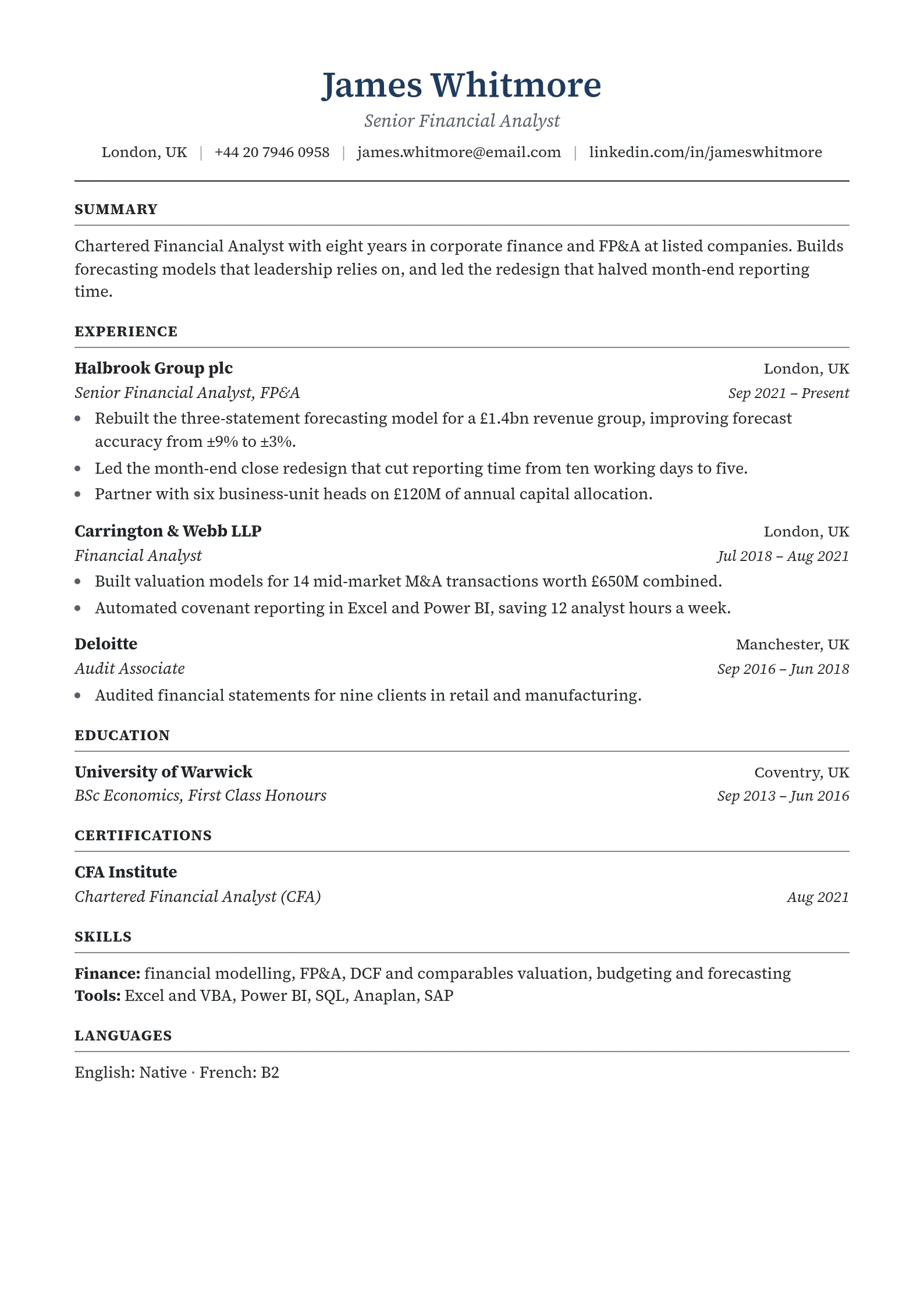
Before (typical US resume entry):
Spearheaded cross-functional initiatives to drive operational excellence, resulting in 30% improvement in team efficiency.
After (Lebenslauf entry):
03/2021 – 08/2024   Operations Analyst, Northwind Logistics, Lisbon (Portugal)
                    - Reduced average order processing time from 48 to 32 hours
                    - Maintained the KPI dashboard for 5 warehouses in Excel and Power BI
                    - Trained 12 new colleagues in the order system
The "after" is not less impressive. It is more checkable. Use only numbers you can defend in an interview.
Length: one to two pages
The Bundesagentur's wording is "Auf maximal zwei Seiten," at most two pages. If you go to a second page, fill it properly: a single orphaned line looks careless. Do not shrink the font below readable size to hold the line.
Signature and closing line
At the bottom you put a place and a date, for example Berlin, 30.10.2026, and optionally your signature. In a PDF you can insert a scanned signature or leave the space blank. The Bundesagentur says a signature is not strictly necessary.
Common mistakes international applicants make
- A "Professional Summary" that fills a third of the page. Put the facts in the table instead.
- Dates that are easy to misread. Use
MM/YYYY. - Two-column or icon-heavy templates. The convention is a plain table, and a design-heavy layout breaks it.
- No place and date at the end. It is small, and it is expected.
- An unexplained gap. Give it a row and a label.
- A selfie as photo. The Bundesagentur recommends a professional photo and says a selfie or a plain passport photo is not the right choice.
A quick self-check
Read your CV top to bottom and answer these:
- Is it one to two A4 pages?
- Does every station have a month and year at both ends?
- Is the newest entry first in every section?
- Are languages listed with CEFR levels?
- Do I end with place and date?
- Can I explain every row in an interview?
If you answer yes six times, you are in good shape. If not, our free Germany check reads your English CV and shows what to change before you start converting. It does not require an account.
Frequently Asked Questions
What is the difference between a CV and a Lebenslauf?
A Lebenslauf is the German CV: a tabular, reverse-chronological summary of one to two A4 pages with month and year for each station. A UK or US CV or resume is usually bullet-based and may use years only.
How long should a German CV be?
The Bundesagentur für Arbeit recommends a tabular CV on one to a maximum of two A4 pages.
Do I need a photo on my German CV?
No. The Bundesagentur für Arbeit writes that a photo is no longer a must, although it is still customary in many industries.
Do I need to sign my German CV?
A signature is not strictly necessary according to the Bundesagentur für Arbeit, but it can show the document is current. A place and date line is customary.
Can I write my German CV in English?
Many international employers accept an English CV, but a job ad in German usually expects a German application. Check the language of the job ad and answer in the same language.
Where to go next
- How to write a German cover letter (Anschreiben)
- Photo and date of birth on a German CV
- CEFR language levels on your CV
- The Bewerbungsmappe checklist
- Applying with a Chancenkarte
Or see the finished result: the German CV template page shows a Lebenslauf built from an English CV.
Sources
- Bundesagentur für Arbeit, Lebenslauf: length, tabular form, order, month and year, personal data, photo, signature, special knowledge.
- Bundesagentur für Arbeit, Bewerbungsunterlagen: the parts of an application and their order, photo guidance.
- Anerkennung in Deutschland: the federal portal for recognition of foreign professional qualifications.
DeutschCV Team
The team behind DeutschCV
The team that builds DeutschCV's Lebenslauf templates, the Germany check and the Anschreiben writer..
Applying in Germany? Start with your CV.
See how ready your CV is for German employers, then turn it into a Lebenslauf and an Anschreiben.
- AI-Powered Writing
- German format
- Free to Build
No card needed. Your first PDF or Word download is free; passes start from 19 €, one payment, no auto-renew.
Continue Reading
View all articles
CEFR Levels on Your CV: How to List German and English Skills

Photo and Date of Birth on a German CV: Required or Optional?

Bewerbungsmappe Checklist: What Goes in a German Job Application

Chancenkarte Job Applications: What Your CV Needs to Show
